


What Is a Coilover Shock and How Does It Work in Racing?

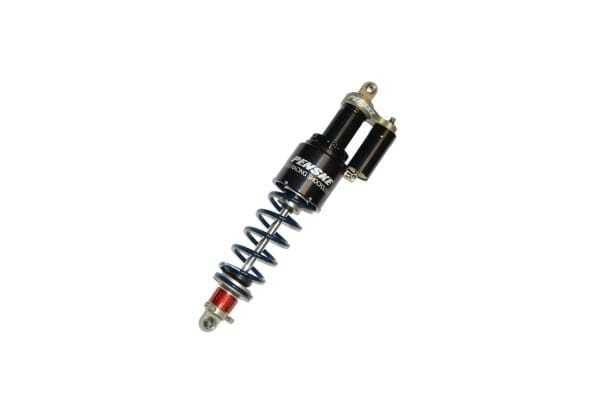
A coilover shock is a shock absorber with a coil spring mounted around its body, so the spring and the shock work as one assembly at each corner. The spring carries the weight of the vehicle and stores energy as the suspension moves. The shock controls how fast that movement happens. Racing teams rely on the coilover shock because it puts ride height, spring rate, and damping adjustment into a single compact unit that a crew can change at the track.
That combination is why coilovers show up on club sports cars, dirt late models, modifieds, and the rear of most road racing motorcycles. This guide covers how a coilover works, how to set ride height and spring rate, what each level of adjustability does, and which Penske Racing Shocks coilovers fit different applications.
What Is a Coilover Shock?
A coilover shock is a shock body that holds a coil spring concentrically around it, with the spring trapped between an upper spring seat and a lower adjustable collar. The whole assembly bolts in as one piece, so spring and shock move together through every inch of travel.
Inside the shock is a body filled with oil, a hard chromed shaft, and a piston that moves through the oil. As the piston travels, oil is forced through ports in the piston and past a stack of thin steel washers called a shim stack. The combination of piston, ports, and shims is the valving, and it determines how much force the shock produces at a given shaft speed.
The spring side of the assembly needs the same attention. Penske makes coilover spring hardware for a range of spring diameters, and the hardware has to match the inside diameter of the spring you run. The 8760 Series Triple Adjustable, for example, comes in 45mm and 55mm body sizes that accept 2.00-inch, 2.25-inch, and 2.50-inch inside diameter springs.
How Does a Coilover Shock Work?
A coilover works by splitting the job of the suspension in two. The spring resists how far the suspension moves, and the shock resists how fast it moves.
When a wheel hits a bump or the car rolls into a corner, the shock shortens, and that direction of travel is compression. When the suspension extends back out, the shock is in rebound. Spring force depends on how far the spring is compressed, while shock force depends on shaft velocity. A shock sitting still produces almost no damping force, which is why the spring sets static ride height and the shock shapes the motion in between.
Shock force is usually discussed in two ranges. Low-speed damping covers slow shaft movement, the kind that comes from weight transfer under braking, acceleration, and corner entry. High-speed damping covers fast shaft movement from curbs, bumps, and ruts. Low-speed behavior leans heavily on bleed, which is oil that bypasses the shim stack through a small orifice or adjuster. High-speed behavior is governed mostly by how the shim stack bends open on the piston face.
Most racing coilovers are monotube designs that carry a nitrogen charge. The gas pressure keeps the oil from cavitating, or forming vapor bubbles, when the piston moves quickly. Penske explains the construction differences in monotube vs. twin-tube shocks and covers gas pressure in detail in nitrogen charging in racing shocks.
How Do You Adjust Ride Height on a Coilover?
You adjust ride height on a coilover by threading the lower spring collar up or down the shock body. Moving the collar up raises that corner, and moving it down lowers it, because the spring compresses to the same length under the same load wherever its seat sits.
Thread pitch makes those changes repeatable. On the 7500 Coil Over DA NASCAR Mexico Spec, Penske uses an ACME-threaded body that changes spring preload by .100 inch per turn. Counting turns lets a crew move ride height and corner weights in known amounts.
Spring preload is the amount the spring is compressed when the shock sits at full extension. Spring rate stays the same no matter how much preload you add, so an extra turn on the collar will never make the car stiffer. Preload changes where the car sits and how much droop travel the wheel has before the spring goes loose on its seat.
The next question most racers ask is what happens to ride height when they change damping. Compression and rebound adjustments leave static ride height where it was, since a shock at rest produces almost no force. They do change how the chassis moves around that position. More rebound slows the shock as it extends, which can hold a corner down longer through a long turn. More compression slows how quickly the chassis settles onto the spring, which affects how fast weight reaches that tire.

How Do You Choose the Right Coilover Spring Rate?
You choose a coilover spring rate by starting from the wheel rate and ride frequency you want, then accounting for the motion ratio of the suspension. The rate printed on the spring is its stiffness at the shock, and the tire feels a different number.
Motion ratio describes how far the shock moves compared with how far the wheel moves. Because the shock usually travels less than the wheel, wheel rate comes out lower than spring rate, and it scales with the square of the motion ratio. Ride frequency is the natural frequency of the sprung mass bouncing on its springs, usually expressed in cycles per minute, and it gives you a way to compare stiffness between cars of very different weights.
Penske walks through the math in its guide to spring rate, wheel rate, and motion ratio and its technical breakdown of ride frequency and CPM in race suspension. The free Spring Curve Calculator helps you plot rates, and the Shocks and Springs guide explains how the two components work together. For the deeper engineering background, Race Car Vehicle Dynamics from SAE International is a long-standing reference on the subject.
Once you have a target rate, you can source racing springs from the Penske parts store.
Why Do Race Cars Use Coilover Shocks?
Race cars use coilover shocks because they combine the spring, the shock, and ride height adjustment in one serviceable unit that packages tightly and can be retuned quickly. A crew can swap a spring, reset ride height, and adjust damping on the same component without touching the rest of the suspension.
Club racers running events sanctioned by the Sports Car Club of America often move between tracks with very different surfaces and layouts, and a coilover lets them change rate and height between weekends.
Penske lists the 7500 and 8760 Series as built to customer specifications and owner rebuildable, and the 7500 is revalvable with a variety of pistons and shim stacks. A coilover that can be rebuilt and revalved keeps up as the car, the driver, and the rules change.
What Adjustments Are Available on a Racing Coilover?
Racing coilovers range from non-adjustable to four-way adjustable. A non-adjustable shock has fixed valving, a single adjustable shock has one external adjuster, a double adjustable shock lets you set compression and rebound separately, and triple and four-way designs split those adjustments further into low-speed and high-speed ranges.
The table below compares Penske coilovers using details from each product page.
|
Penske coilover |
Adjustability |
Reservoir |
Where it fits |
|---|---|---|---|
|
Fixed bleed jet, or one shaft adjuster for rebound, compression, or both |
None |
Track and street builds |
|
|
Separate compression and rebound |
None |
Track and street builds |
|
|
8300 Double Adjustable Piggy Back or Remote Canister Coil-Over Shock |
Separate compression and rebound |
Piggyback or remote |
Late model, modified, and sports car |
|
25 clicks low-speed compression, 17 clicks high-speed compression, 30 clicks rebound |
Piggyback or remote |
Professional sports car and open wheel |
|
|
Four-way adjustable, thru-rod design |
Piggyback |
GT3 sports cars |
The 8760 shows how these adjusters divide the work. Its high-speed compression adjuster acts on preloaded shims on the piston face, while its rebound and low-speed compression adjusters use a needle and seat to control a bleed bypass. That is why a low-speed change shows up mostly in body motion and a high-speed change shows up mostly over curbs and bumps.
Racers often ask if a rebound change also moves compression. On a double, triple, or four-way coilover, each direction has its own adjuster. On a single adjustable shock, the bleed path can affect rebound, compression, or both depending on how the shock is built. Penske covers the full range in what adjustable shocks are and how they work, and the reservoir options are explained in remote canister vs. piggyback shocks.
Which Penske Coilover Fits Your Application?
The right Penske coilover depends on the type of racing you do and the adjustment range you can use. These are the best starting points by application.
- Road racers and club sports car drivers can find the 7500, 8300, 8760, and 8781 coilovers, plus pistons, shims, and tools, in the sports car collection.
- Dirt and asphalt late model teams will find the 7300 and 8300 series coilover systems in the late model collection.
- Track day drivers with dual-purpose cars can start with the 7500 Series double adjustable coilovers in the street car collection.
- Grassroots cars that use small spring diameters, such as mod-lites, midgets, and legends, are the target for the 7000 Series Small Bore Shock.
- Motorcycle road racers run a coilover at the rear of the bike, and Penske builds road racing motorcycle rear shocks for that job.
- NASCAR Mexico competitors use the spec 7500 double adjustable coilover, and Penske supports that series through its NASCAR Mexico program.
If you are not sure which model or valving fits your car, Penske's S3 program is free and puts you in touch with the team to spec the shock, build the setup, and support it after the sale.
How Do You Know a Coilover Is Performing Correctly?
You know a coilover is performing correctly by testing it on a shock dyno and comparing the result to its baseline damper curve. A shock dyno strokes the shock at controlled velocities and records the force it produces, and the plot of force against shaft velocity is the damper curve.
Dyno testing catches problems a driver may not feel, such as lost gas pressure, worn seals, contaminated oil, and hysteresis, which is a gap between the force a shock makes as shaft speed rises and the force it makes at the same speed as it falls. Penske explains the process in what a shock dyno is and how it works, and the free guide on how to read a shock dyno graph shows what to look for. For equipment or outside testing, see Penske dyno products and services.
Rebuild intervals vary a lot by discipline, and Penske breaks them down in how often a racing shock should be rebuilt. When it is time, a Penske shock service request gets your coilovers inspected, rebuilt, and dyno checked.
Coilover Shock FAQs
Is a coilover the same as a shock absorber?
A coilover is a shock absorber with a coil spring mounted on its body. Every coilover contains a shock, but some suspensions mount the spring separately and run the shock on its own. Penske offers the 7500 Series in both coil-over and non coil-over versions for that reason.
Does adjusting spring preload change spring rate?
Spring rate stays the same when you change preload. Turning the collar changes ride height, corner weight, and the amount of droop travel before the spring unloads. To make a corner stiffer, you need a higher rate spring or a change in motion ratio.
Can a coilover use an air spring instead of a coil spring?
Yes. The Penske Air Spring is a self-contained unit that replaces a conventional coil spring and can produce progressive and digressive spring rates from one unit. It was first developed for dirt late models, where dual and triple rate spring curves are common.
Do I need a single, double, or triple adjustable coilover?
The answer depends on how much time you have to test and how much your track conditions change. More adjusters give you more control, but they only help if you have a process for using them. Penske lays out the decision in single vs. double adjustable shocks.
How often should coilover shocks be serviced?
Service intervals depend on the discipline, the number of laps or hours, and how hard the shocks are worked. Oil, seals, and gas charge all degrade with use, and the change is often gradual enough that a driver adapts without noticing. A dyno check during service shows if the shock still matches its original curve.
Getting Your Coilover Setup Right
A coilover gives you control over spring rate, ride height, and damping in one place. Start with the right spring rate for your motion ratio and target ride frequency, set ride height and corner weights with the collar, then use the damping adjusters to shape how the car moves.
If you want help choosing a model or building a baseline, join Penske's S3 program and work directly with the team on your shock, setup, and ongoing support. If your coilovers are due for a rebuild or you want to know how they compare to their original curves, send them in for Penske shock service. For teams that want their own testing data, the Penske provides products, support and services regarding dyno equipment and testing.