


Spring Rate in Racing Suspension: Wheel Rate, Motion Ratio, and How to Calculate What Your Tire Actually Feels

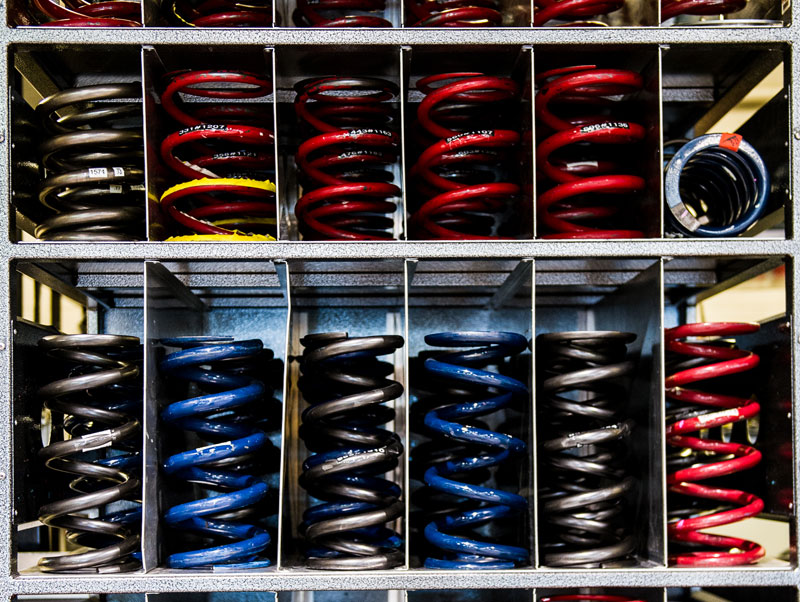
Spring rate is one of the most referenced numbers in racing setup, and understanding it correctly starts with one fact: the number on your spring is not what your tire feels.
That single disconnect is responsible for more setup confusion than almost anything else in racing. You can read the spring rate off the coil, put it on a setup sheet, and still have no accurate picture of how stiff that corner of the car actually is. Between the spring and the tire, the suspension changes everything through a concept called wheel rate, and most setup mistakes trace directly back to treating spring rate and wheel rate as the same thing.
This guide explains what spring rate actually means, how to calculate wheel rate from spring rate and motion ratio, what typical spring rates look like by discipline, and the five mistakes that come from treating the number on the spring as the final answer. It covers sprint car shocks, sports car suspension, drag racing shocks, and everything in between.
What Is Spring Rate in Racing Suspension?
Spring rate (k) is the force required to compress or extend a spring by one unit of distance. In the US it's measured in pounds per inch (lb/in). In metric, Newtons per millimeter (N/mm). The relationship is linear and defined by:
F = k × x
Where F is force, k is spring rate, and x is displacement. A 200 lb/in spring requires 200 lbs to move one inch, 400 lbs to move two inches, 600 lbs to move three inches. The rate doesn't change through the stroke. That constant ratio is what defines a linear spring, and linear springs are what most race cars run.
When the car brakes, corners, accelerates, or hits a bump, the suspension tries to move. The spring resists that movement. A stiffer spring resists more, so the car moves less. A softer spring resists less, so the car moves more. That movement shows up as body roll, dive, squat, and how quickly the car settles after a disturbance. On a street car coilover or a late model dirt track setup, the relationship between spring rate and suspension movement works the same way.
That's the foundation. The problem is that it's only the first layer. The number describes how the spring behaves by itself. Once it's installed, the suspension changes what the tire actually sees.

What Is the Difference Between Spring Rate and Wheel Rate?
Spring rate is the stiffness of the spring measured in isolation. Wheel rate is the stiffness the tire actually experiences once the spring is installed in the suspension.
They are almost never the same number, and treating them as interchangeable is the root cause of most spring rate mistakes.
The gap between them exists because the spring never mounts directly at the wheel. It sits somewhere along the suspension linkage, and the geometry of that linkage acts as a lever that changes how much of the spring's stiffness reaches the tire. That lever relationship is called the motion ratio, and it's what separates spring rate from wheel rate.
Racing Aspirations has a thorough explanation of how wheel rate is calculated and why it's the number that actually governs how the car behaves.
How to Calculate Wheel Rate From Spring Rate and Motion Ratio
Motion ratio (MR) is the ratio of spring displacement to wheel displacement. If the wheel moves 1 inch and the spring moves 0.7 inches, the motion ratio is 0.7. Motion ratio is determined by where the spring mounts along the control arm relative to the pivot point and the wheel centerline.
The formula for wheel rate is:
WR = k × MR²
The motion ratio is squared because leverage affects both how far the spring moves and how much force transmits back through the suspension.
Here is a worked example step by step:
- Start with a spring rate of 400 lb/in and a motion ratio of 0.7.
- Square the motion ratio: 0.7 × 0.7 = 0.49
- Multiply spring rate by the squared motion ratio: 400 × 0.49 = 196 lb/in
The tire is feeling roughly half the spring's rated stiffness.
Now run the same spring with a motion ratio of 0.9:
- Square the motion ratio: 0.9 × 0.9 = 0.81
- Multiply: 400 × 0.81 = 324 lb/in
Same spring, completely different wheel rate. This is why two cars running the same spring can feel completely different on track. The spring rate matches. The system doesn't.
For a deeper look at how motion ratio is analyzed and optimized in competition suspension design, OptimumG's motion ratio optimization resource covers the geometry and engineering behind it.
What Is Installation Ratio and How Is It Different From Motion Ratio?
Installation ratio is the inverse of motion ratio (1/MR). It describes how much the wheel moves relative to the spring rather than how much the spring moves relative to the wheel. Both terms describe the same geometric relationship from opposite directions.
Motion ratio is the more common term in setup and engineering contexts. Installation ratio appears more frequently in manufacturer documentation and some suspension design software. If you encounter either term, they're describing the same thing. A motion ratio of 0.7 is the same relationship as an installation ratio of 1.43.
One additional variable: if the spring is mounted at an angle rather than perfectly vertical, it loses additional effectiveness. The correction uses the cosine of the mounting angle. A 10-degree lean reduces effective spring rate measurably. Most teams working at a serious level account for this in their wheel rate calculations.
Static vs. Dynamic Spring Rate: Bump Rubbers and Real-World Rate Changes

The number on the spring is its static rate, measured at rest or under very slow compression. That's the figure on every spec sheet and setup card, and it's what this guide refers to when discussing spring rate unless noted otherwise.
Under actual operating conditions, effective rate can shift. Temperature affects spring material slightly over time. More practically, bump rubbers (also called jounce bumpers) introduce a significant rate change when contacted. A bump rubber is a progressive rubber stop that compresses when the suspension approaches the limit of its travel. Once contacted, it adds rate on top of the main spring, effectively stiffening that corner without changing the spring itself.
Many teams use softer main springs paired with bump rubbers to get compliant initial behavior with resistance near full compression. When evaluating a setup, it's worth knowing at what point in the stroke the bump rubber engages and how much rate it adds, because that changes the effective rate in a range that matters on track. Keeping shock nitrogen pressure in spec is part of maintaining consistency through this range, since pressure drift affects how the damper interacts with the spring. The Penske blog on nitrogen charging in racing shocks covers how pressure affects damping behavior and why it belongs in any consistent baseline.
Sprung Mass, Unsprung Mass, and How Corner Frequency Connects to Spring Rate
Sprung mass is everything the spring supports: chassis, body, engine, driver. Unsprung mass is everything below the spring: wheel, tire, brake rotor, hub, and the unsprung portion of the control arms. Spring rate affects how the sprung mass behaves. Unsprung mass affects how quickly the wheel can follow the road surface. A heavier unsprung assembly needs more compliance from the suspension to maintain consistent contact over bumps.
Wheel rate and the sprung mass at each corner together determine the corner's natural frequency, measured in Hz or cycles per minute (CPM).
f = (1/2π) × √(WR / m)
The calculation only works correctly if wheel rate and sprung mass are measured in consistent units. A stiffer wheel rate or lighter corner raises the natural frequency. A softer wheel rate or heavier corner lowers it. Most road race cars target roughly 1.5 to 3.0 Hz. Street cars typically run 1.0 to 1.5 Hz.
If two corners of the car have significantly different natural frequencies, the car pitches and rolls unevenly because each end is oscillating at a different rate. Matched front-to-rear frequencies, or a deliberate calculated split, is a setup target rather than an accident. For a complete breakdown of how to calculate and apply corner frequency, the Penske guide to natural frequency and CPM in race car suspension covers the full calculation, discipline-specific targets, and how to use frequency as a diagnostic tool. [Link to ride frequency blog once published.]
Linear vs. Rising Rate Springs: Which Is Right for Racing?
A linear spring has the same rate throughout its travel. A rising rate spring (also called progressive rate) gets stiffer as it compresses. This can come from the spring itself through variable pitch coils, or from the suspension geometry creating an increasing motion ratio through the stroke.
Rising rate setups are harder to tune because the effective wheel rate changes continuously through wheel travel. The benefit is soft initial compliance with increasing resistance near the limits of travel, which can help manage bottoming while keeping the car compliant over small bumps. For most race applications, linear springs are preferred because their behavior is predictable and consistent. The same logic applies to shock valving: the Penske blog on linear, progressive, regressive, and digressive shock valving explains how each curve type affects suspension behavior and when each is appropriate.
Typical Spring Rates by Racing Discipline
Spring rate ranges vary widely by application. These are reference points, not universal targets. Actual wheel rate, corner weight, motion ratio, and track conditions all determine what works for a specific car.
Street cars and street performance typically run 150 to 400 lb/in depending on the application. Ride quality and compliance over varied surfaces are the priorities.
Sports cars and road race cars without significant aerodynamic load typically run 300 to 700 lb/in. The range shifts based on weight, geometry, and whether the car runs on smooth or bumpy circuits.
Sprint cars run a wide range depending on track condition. Front springs commonly fall between 300 and 700 lb/in, with rear springs varying significantly based on whether the car runs a stiff or soft rear setup for the surface.
Dirt late models commonly run 150 to 400 lb/in at the left rear depending on track condition, with right rear and front springs varying considerably by chassis and surface.
Stock cars on asphalt run stiffer rates to manage aerodynamic load, commonly 600 to 1,200 lb/in or higher depending on the division and track type.
High-downforce road race cars can run spring rates that appear extreme by other standards because aerodynamic load effectively adds corner weight at speed, requiring much stiffer springs to maintain consistent ride height.
Drag racing setups are tuned specifically for weight transfer and launch consistency. Front spring rates are often very soft intentionally to allow the front to rise freely, while rear spring selection focuses on controlling squat and traction.
Mistake No. 1: Why Spring Rate Doesn't Equal Wheel Rate
The easiest way to get setup wrong is to treat the number on the spring as what the tire is dealing with.
A 200 lb/in spring doesn't produce 200 lb/in at the wheel unless the spring is mounted directly at the tire with a 1.0 motion ratio, and most cars aren't built that way. Apply the formula and the real number is usually significantly lower.
This affects everything downstream. If you're evaluating stiffness, comparing setups, or trying to predict how a spring change will behave, using spring rate instead of wheel rate gives you the wrong answer every time.
Two cars with identical spring rates but different motion ratios are running fundamentally different setups. Car A with a 0.9 motion ratio and a 300 lb/in spring has a wheel rate of 243 lb/in. Car B with a 0.7 motion ratio and the same spring has a wheel rate of 147 lb/in. On the setup sheet they look identical. On track they feel nothing alike.
Mistake No. 2: Why Copying Spring Rates Between Cars Doesn't Work
This is the first mistake playing out in the real world.
You find out what a fast car is running and copy the spring rates. Sometimes it's close. More often it isn't. The reason is that you copied spring rate, not wheel rate, and your suspension geometry isn't the same as theirs.
If your motion ratio differs, your wheel rate differs. If your corner weights differ, the car responds at a different speed with the same spring. If the spring is mounted at a slightly different angle, the effective rate changes again. The setup sheet matches. The car's behavior doesn't.
There's also everything surrounding the spring. Damper tune, sway bars, tires, and how the driver loads the car all interact with that spring rate to produce the final behavior. That's why building a proper baseline setup matters more than copying numbers. A documented baseline gives you a reference point calibrated to your specific car, not someone else's.
Mistake No. 3: Why a Stiffer Spring Rate Isn't Always Better for Racing
The car feels loose, so the instinct is to add spring rate. On a smooth track, that often works. More spring reduces body movement, helps the car settle faster under load, and makes it feel sharper in direction changes.
On a rough track, the same logic starts to break down. A stiffer spring can create control problems if the damping package is no longer controlling the suspension movement correctly. That’s usually where you start seeing oscillation, float, and lack of control over rough sections instead of the car settling cleanly. The tire loses more consistent contact with the surface, and the car starts feeling unsettled even though nothing changed in how it’s being driven.
Going softer lets the suspension move more freely, which helps the tire stay connected over uneven sections. That’s where mechanical grip comes from. The tradeoff is that more movement still needs to be controlled correctly with damping or the car can start feeling lazy in transitions or on corner exit.
The right spring rate balances those two things for the conditions. Smooth surfaces reward control. Rough surfaces need compliance. High-downforce cars need more spring support to manage aerodynamic load. Low-gri
Mistake No. 4: How Spring Rate and Shock Damping Must Move Together
You change the spring rate and the car gets worse. The logic of the change was sound, but the result doesn't match what you expected. Usually this comes down to the spring and damper no longer working as a matched system.
The spring controls how much the suspension wants to move. The damper controls how fast that movement happens and how quickly the car settles after being disturbed. When they're matched, the car moves a predictable amount at a predictable rate and settles in a way that feels controlled.
When they're not matched, things come apart quickly. Install a stiffer spring without increasing damping and the suspension moves faster than the damper can manage. The car feels harsh and unsettled. Install a softer spring without reducing damping and the damper starts to dominate the system, slowing the suspension down too much. The car feels sluggish and unresponsive.
Neither spring choice was wrong on its own. The problem is the system wasn't adjusted together. Every spring change has implications for how the damper needs to be tuned, and if damping doesn't move with it, the car won't respond the way the spring change was intended to produce. Understanding the difference between low-speed and high-speed damping is important here, because not all damping adjustments work the same way and knowing which one to move with a spring change matters. If the car is at the point where independent compression and rebound control is needed, the Penske blog on double adjustable shocks explains when that level of adjustability makes sense. For a detailed look at making the spring-to-damping call correctly, the Penske blog on Spring Rate or Damping? How to Stiffen Rear Suspension Properly covers exactly how to work through it.
Mistake No. 5: When Spring Rate Isn't the Problem in Your Suspension Setup
You make a spring change, the car feels different, but it doesn't actually improve. So you try another change. Then another. The car keeps changing feel without ever getting better, and before long you're chasing a setup that never settles.
At that point, spring rate is probably not the issue.
Springs control how much the car moves and how it supports load. They don't control damping behavior, alignment, tire behavior, or weight distribution. If the root cause is in any of those areas, spring changes will shift the feel without fixing the problem. Each change masks the issue just enough to seem like progress, then exposes it again in a different form.
The way out is to look at the system. A car that bottoms out might have a spring problem, or it might have a travel or damping problem. A car that feels unstable over bumps might need less spring, or it might need the damper to better control the movement that's already happening. A car that's slow to respond might not need more spring at all. The Penske breakdown of the most common racing suspension issues covers how to identify which part of the system is actually driving the behavior before making changes.
Identifying which part of the system is actually causing the behavior narrows the problem down to real solutions. For a structured way to work through that, the Penske blog on How to Baseline Your Suspension Setup walks through building a documented reference point, and Race Suspension Tuning Basics covers the fundamentals of what to adjust and when. Teams that want hands-on help working through the full system can connect with a specialist through Penske's S3 program.
What Is a Good Spring Rate for Racing?
A good spring rate keeps the tire connected to the track while keeping the car controlled.
Too stiff and the suspension can't move enough to follow the surface. The tire loses contact over bumps and the car loses grip. Too soft and the suspension moves too much. The car becomes slow to respond and hard to place precisely.
The right number balances those two things for the track conditions. Smooth surfaces allow stiffer springs for sharper response. Rough surfaces need softer springs so the tire can stay in contact. If the car is nervous and bouncy, it's usually too stiff. If it's lazy and slow to settle, it's usually too soft.
Judge it by what the car is doing, not by what the number says.
FAQ: Spring Rate in Racing Suspension
What is spring rate in racing?
Spring rate is the force required to compress a spring by one unit of distance, measured in pounds per inch (lb/in) in the US or Newtons per millimeter (N/mm) in metric. It describes how stiff the spring is. A 300 lb/in spring requires 300 lbs of force to compress it one inch. The rate stays constant throughout the spring's travel, which is what defines a linear spring.
What is the difference between spring rate and wheel rate?
Spring rate is the stiffness of the spring measured in isolation. Wheel rate is the effective stiffness at the tire after accounting for the suspension's leverage, called the motion ratio. Wheel rate is calculated as spring rate multiplied by the motion ratio squared. Because motion ratios are almost always less than 1.0, wheel rate is almost always lower than spring rate. The tire never feels the full spring rate unless the spring is mounted directly at the wheel with a 1.0 motion ratio.
How do I calculate wheel rate from spring rate?
Multiply the spring rate by the motion ratio squared. If the spring rate is 400 lb/in and the motion ratio is 0.7, the wheel rate is 400 × (0.7²) = 400 × 0.49 = 196 lb/in. The motion ratio is the ratio of spring travel to wheel travel and is determined by where the spring mounts on the suspension relative to the pivot point and wheel centerline.
What is a good spring rate for a race car?
It depends on the application. Street cars typically run 150 to 400 lb/in. Non-aero road race cars commonly run 300 to 700 lb/in. Stock cars on asphalt often run 600 lb/in and above. Dirt late models and sprint cars vary widely based on track condition, with softer springs for tacky surfaces and stiffer springs for slick conditions. The right spring rate is the one that keeps the tire connected to the track while keeping the car controlled for the specific surface and conditions.
Why do cars with the same spring rates feel different?
Because spring rate is not wheel rate. Different suspension geometries produce different motion ratios, which produce different wheel rates from the same spring. Different corner weights also mean the same wheel rate produces different natural frequencies at each corner. Two cars can have identical spring rates on paper and completely different effective stiffness at the tire.
What is the difference between linear and progressive spring rate?
A linear spring has the same rate throughout its travel. A progressive or rising rate spring gets stiffer as it compresses. Most race cars run linear springs because the behavior is predictable and consistent throughout the stroke. Progressive springs are harder to tune because the effective rate changes as the suspension moves.
Does spring rate affect shock absorber tuning?
Yes, directly. The spring controls how much the suspension wants to move. The damper controls how fast that movement happens. Every spring rate change affects how the damper needs to be tuned. Installing a stiffer spring without increasing damping makes the car feel harsh. Installing a softer spring without reducing damping makes the car feel sluggish. Spring and damper changes need to be made together as a system, not independently.
What is installation ratio in suspension?
Installation ratio is the inverse of motion ratio (1/MR). It describes how much the wheel moves relative to the spring rather than how much the spring moves relative to the wheel. Both terms describe the same geometric relationship from opposite directions. A motion ratio of 0.7 is the same as an installation ratio of approximately 1.43.
One thing to keep in mind is that different engineers, teams, and software packages sometimes define motion ratio differently. Some calculate it as wheel travel divided by spring travel, while others define it the opposite way, so it’s important to verify which version is being used before comparing calculations.
For automotive racing shocks or Penske shock components built to work with your spring selection, understanding what spring rate actually does once it's on the car is where the whole setup process starts.